
26 September 2026
Moon Phases Calendar Australia 2027: Every Full and New Moon
Every new moon, first quarter, full moon and last quarter for 2027 in Australian Eastern time, with notes on time zones and what the moon actually looks like from the south.
 Save
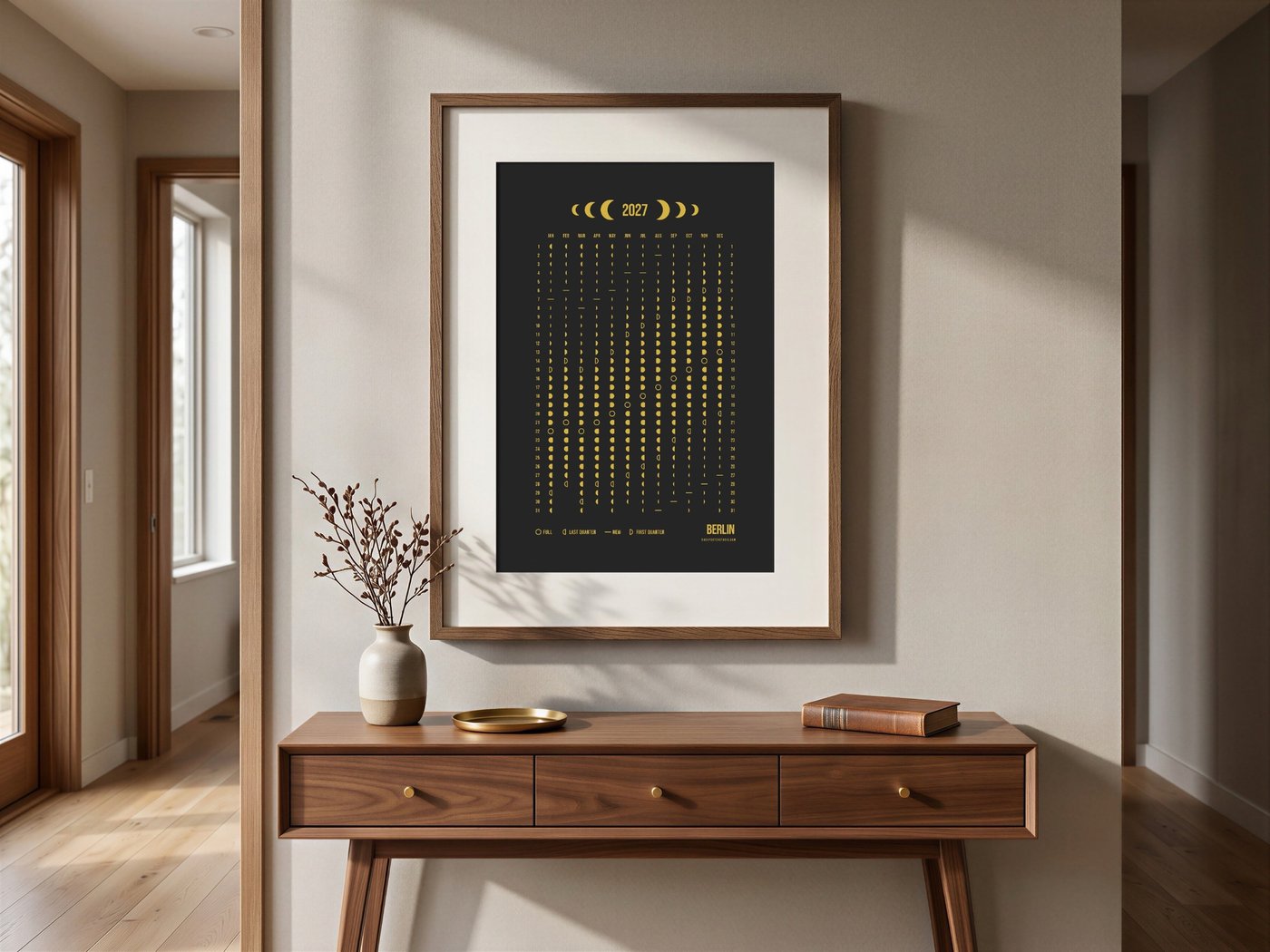
If you're planning a camping trip, a night of astrophotography, a fishing weekend or just want to know when the next full moon is, here is the complete list of moon phases for 2027. All times are local time for Sydney (Australia/Sydney), which means AEDT during daylight saving and AEST for the rest of the year — the switch is already accounted for in the times below.
Further down you'll find the dates broken up by season, notes on the traditional full moon names (and why they read oddly here), and how to work out the times for Perth, Darwin, Adelaide or Brisbane.
The quick answer: full moons in Australia in 2027
| Date | Time (Sydney) | Traditional name |
|---|---|---|
| Fri 22 January | 23:17 | Wolf Moon |
| Sun 21 February | 10:24 | Snow Moon |
| Mon 22 March | 21:44 | Worm Moon |
| Wed 21 April | 08:27 | Pink Moon |
| Thu 20 May | 20:59 | Flower Moon |
| Sat 19 June | 10:45 | Strawberry Moon |
| Mon 19 July | 01:45 | Buck Moon |
| Tue 17 August | 17:29 | Sturgeon Moon |
| Thu 16 September | 09:04 | Harvest Moon |
| Sat 16 October | 00:47 | Hunter's Moon |
| Sun 14 November | 14:26 | Beaver Moon |
| Tue 14 December | 03:09 | Cold Moon |
Twelve full moons, no blue moon by the two-full-moons-in-a-month definition. The moon looks full to the eye for roughly a night either side of these times, so if a full moon falls at 10 in the morning, both the evening before and the evening after will look full when it rises.
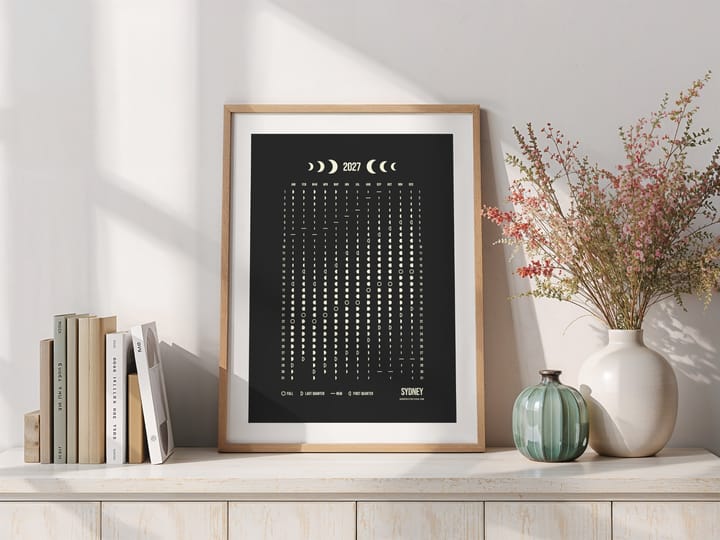
Custom Yearly Moon Phase Calendar, Printable PDF for Any Location
A full year of moon phases calculated for your town, in colours you choose.
€9.90≈ $11.08
Design yoursEvery phase, month by month
January to March 2027
| Date | Time | Phase |
|---|---|---|
| 8 January | 07:25 | New moon |
| 16 January | 07:35 | First quarter |
| 22 January | 23:17 | Full moon |
| 29 January | 21:56 | Last quarter |
| 7 February | 02:56 | New moon |
| 14 February | 18:59 | First quarter |
| 21 February | 10:24 | Full moon |
| 28 February | 16:17 | Last quarter |
| 8 March | 20:30 | New moon |
| 16 March | 03:25 | First quarter |
| 22 March | 21:44 | Full moon |
| 30 March | 11:54 | Last quarter |
April to June 2027
| Date | Time | Phase |
|---|---|---|
| 7 April | 09:51 | New moon |
| 14 April | 08:57 | First quarter |
| 21 April | 08:27 | Full moon |
| 29 April | 06:18 | Last quarter |
| 6 May | 20:59 | New moon |
| 13 May | 14:44 | First quarter |
| 20 May | 20:59 | Full moon |
| 28 May | 23:58 | Last quarter |
| 5 June | 05:40 | New moon |
| 11 June | 20:56 | First quarter |
| 19 June | 10:45 | Full moon |
| 27 June | 14:54 | Last quarter |
July to September 2027
| Date | Time | Phase |
|---|---|---|
| 4 July | 13:02 | New moon |
| 11 July | 04:39 | First quarter |
| 19 July | 01:45 | Full moon |
| 27 July | 02:55 | Last quarter |
| 2 August | 20:05 | New moon |
| 9 August | 14:54 | First quarter |
| 17 August | 17:29 | Full moon |
| 25 August | 12:27 | Last quarter |
| 1 September | 03:41 | New moon |
| 8 September | 04:31 | First quarter |
| 16 September | 09:04 | Full moon |
| 23 September | 20:21 | Last quarter |
| 30 September | 12:36 | New moon |
September is the month with two new moons — one on the 1st and one on the 30th.
October to December 2027
| Date | Time | Phase |
|---|---|---|
| 7 October | 22:48 | First quarter |
| 16 October | 00:47 | Full moon |
| 23 October | 04:29 | Last quarter |
| 30 October | 00:37 | New moon |
| 6 November | 19:00 | First quarter |
| 14 November | 14:26 | Full moon |
| 21 November | 11:48 | Last quarter |
| 28 November | 14:24 | New moon |
| 6 December | 16:22 | First quarter |
| 14 December | 03:09 | Full moon |
| 20 December | 20:11 | Last quarter |
| 28 December | 07:12 | New moon |
Time zones: your date may differ
Australia covers three main time zones, and several of these phases fall close enough to midnight that the date changes depending on where you are.
- AEST/AEDT (NSW, Vic, Tas, ACT, Qld): Queensland doesn't use daylight saving, so between early October and early April it runs an hour behind Sydney.
- ACST (SA, NT): 30 minutes behind Sydney's standard time, and Darwin doesn't shift for daylight saving.
- AWST (WA): two hours behind AEST, three behind AEDT.
A clear example: the full moon on 16 October at 00:47 in Sydney happens at 21:47 on 15 October in Perth. Same moment, different date. The new moon on 30 October at 00:37 Sydney time is likewise 29 October in the west. If you're planning around a date rather than an instant, check your own zone before you book anything.
That's the main reason our calendars are calculated for the city you enter rather than one national default — Broome, Hobart and Alice Springs each get their own figures.
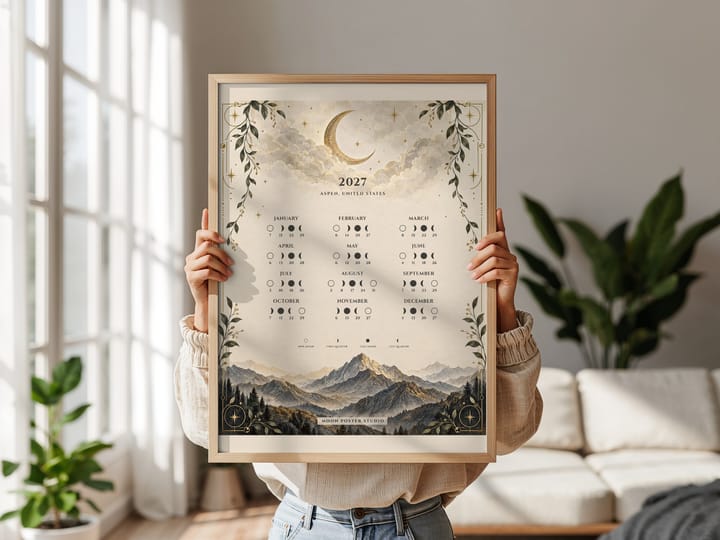
Custom Moon Phase Calendar for Your Year and Location
Design it online with your place, year and colours, then download a print-ready PDF.
€9.90≈ $11.08
Design yoursAbout those full moon names
Wolf Moon, Snow Moon, Harvest Moon — these names come from the Northern Hemisphere, largely from North American and European folk traditions, and they follow northern seasons. So the "Cold Moon" in December lands in the middle of an Australian summer, and the "Strawberry Moon" arrives in the depths of June. They're worth knowing because you'll see them everywhere online, but they describe someone else's year.
If you'd rather map them onto the local calendar, the simplest shift is to read each name six months across: the September Harvest Moon of the north corresponds roughly to our March full moon. Plenty of Australians just use the month instead — the August full moon, the November full moon — and Aboriginal and Torres Strait Islander traditions hold their own, far older, lunar knowledge tied to this continent's seasons rather than to imported names.
The moon looks different down here
If you've only ever seen diagrams drawn for the north, the real sky can be disorienting. From Australia:
- A waxing crescent is lit on the right-hand side in northern diagrams, but appears lit on the left from here.
- The first quarter moon shows its left half lit; the last quarter shows its right half.
- The familiar face of the "man in the moon" appears upside down, which is why many Australians see a rabbit, or nothing in particular at all.
It isn't the moon that has changed — you're simply standing on the other side of the planet, looking at it from a different angle. Worth remembering when you buy a moon chart online, because most stock designs are drawn for northern viewers and will show the phases mirrored.
Planning by moonlight
A few practical uses for the list above:
- Stargazing and astrophotography. Aim for the week around each new moon — 8 January, 7 February, 8 March and so on. The nights near a full moon wash out everything faint, including the Milky Way core, which sits high overhead through the middle of the year.
- Camping and bushwalking. The opposite applies if you want light to walk by. A full moon rises around sunset and stays up all night.
- Coastal trips. The biggest tidal ranges come within a day or two of new and full moons. Check a tide table for your beach, but the moon dates tell you which weekends to look at.
- Dates that matter. Plenty of people mark a birthday, an anniversary or a wedding by checking what the moon was doing that night.
Putting the year on the wall
A printed chart is easier to glance at than a phone. If you want one for 2027, our moon calendar is generated for the exact place you nominate — your suburb, not a capital-city approximation — with phases drawn as they appear from the Southern Hemisphere and the times in your own zone. You choose the colours, the year and the format, then download a print-ready PDF to print at home on A3 or take to a local print shop for something larger.
Custom Yearly Moon Phase Calendar, Printable PDF for Any Location
A full year of moon phases calculated for your town, in colours you choose.
€9.90≈ $11.08
Design yoursIt's a file, delivered as soon as payment clears, so there's nothing to wait for in the post. And if you'd like a second one for a different city — a parent's town, a place you're travelling to — it's a separate design, calculated fresh for that location.
Get new articles and designs by email
New calendars, art and mockups, and the odd offer — about once a month.
Unsubscribe any time. See the privacy policy.